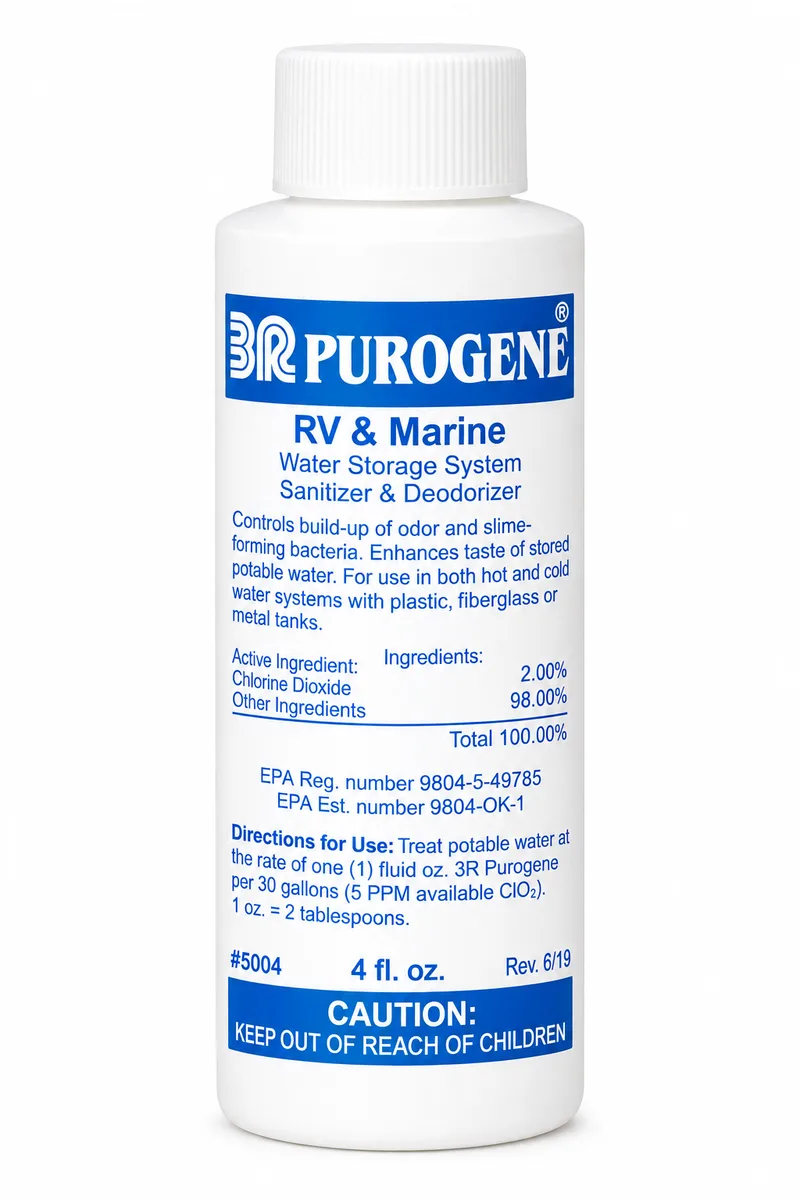
Purogene Drinking Water Preserver — 4 oz
4.6110 ratings on Amazon
Stabilized chlorine dioxide for long-term storage of drinking water.
Size
- 4 oz$16.95List $29.95$4.24/oz
- 16 oz$28.95List $59.95$1.81/oz
- 128 oz$89.96List $109.96$0.70/ozBest per oz Ships free
The 128 oz works out at $0.70/oz against $4.24/oz here, and it ships free.
| Price | $16.95 List $29.95 Save $13.00 |
|---|---|
| Item | S035001 |
| Availability | In stock, ships today |
- Ships from our own stock, usually the next working day
- Free shipping over $49 — $5.99 below it
- Thirty days to return it unopened
- Card handled by Stripe; we never see the number
Buying by the case? Wholesale pricing for schools, labs and resellers — a quote, an invoice against a purchase order, and a W-9 the same day.
What this bottle covers
| Keeps drinkable | 120 gallons of stored water |
|---|---|
| Dose | 1 fl oz per 30 gallons — 5 ppm available ClO₂ |
| Sanitizes a tank of | 13 gallons |
| Registration | EPA Reg. No. 9804-5 — approved label |
- EPA Reg. No. 9804-5
- Made in the USA
- Ships from our own stock
- Thirty days to return it unopened
How much do I need?
Every figure comes from the approved label, printed beside the sentence it came from.
You need
12.8fl oz
of Purogene for a 40 gallon tank
- Citric acid
- 1.6 oz
- Strength
- 50 ppm available ClO₂
- Then
- Stand one hour, then drain and flush.
Enough to do this job once
For each 50 gallons of tank capacity, mix 16 fl. oz. of Purogene with 1/4 cup (2 oz.) citric acid or equivalent in a plastic container. Let mixture stand five (5) minutes. Dilute activated concentrate with two (2) gallons of potable water.EPA Reg. No. 9804-5, Bio-Cide International, Inc. — approved label
How the three sizes compare
| Bottle | Keeps drinkable | Sanitizes a tank of |
|---|---|---|
| 4 oz | 120 gallons | 13 gallons |
| 16 oz | 480 gallons | 50 gallons |
| 128 oz | 3,840 gallons | 400 gallons |
One fluid ounce per 30 gallons to keep stored water drinkable — 5 ppm available chlorine dioxide. Sanitizing a tank is a separate, stronger procedure at 16 fl oz per 50 gallons of capacity. Both are the approved label’s own figures for EPA Reg. No. 9804-5.
Why chlorine dioxide and not bleach
Most instructions for an RV fresh water tank still say household bleach, and most of the alternatives offered beside it — vinegar, baking soda, hydrogen peroxide — come with the caveat that they do not work as well. Chlorine dioxide is what the registered label covers for sanitizing a potable water storage tank, at a stated concentration and a stated contact time, which is the part a caveat cannot replace.
It is a different chemical from chlorine, despite the name, and it does not leave the taste. That is why it is used on water people are going to drink: US municipal systems have treated with it since 1944.
Stored properly and sealed, treated water stays drinkable for five years. That is the whole point of the product — water put away now and forgotten until it is needed.
How it goes
Work out the dose
One fluid ounce per 30 gallons to preserve stored water. Sanitizing a tank is a stronger, separate procedure and the calculator does both.
Add it and leave it
Straight into the tank or the container. Nothing to run, nothing to plug in, nothing to replace.
Drinkable five years on
Sealed and stored properly, that is what the product is for: water put away now and forgotten until it is needed.
Questions about water treatment
- How long does treated water stay drinkable?
- Five years, stored properly and sealed. That is what the product is for: water put away now and forgotten until it is needed.
- How much goes in per gallon?
- One fluid ounce per 30 gallons to keep stored water drinkable — 5 ppm available chlorine dioxide. Sanitizing a tank is a different, stronger procedure, and the calculator does both.
- Does it taste of chlorine?
- Chlorine dioxide is a different chemical from chlorine and does not leave the same taste. At the concentrations on the label it is used precisely because the water stays drinkable.
- Can I use it in an RV fresh water tank?
- Yes — that is the commonest use. The label covers sanitizing potable water storage tanks, and there is a step-by-step guide for RV tanks on this site.
Also in the shop
One parcel, one shipping charge — and free over $49.00.